 Beyond Turing
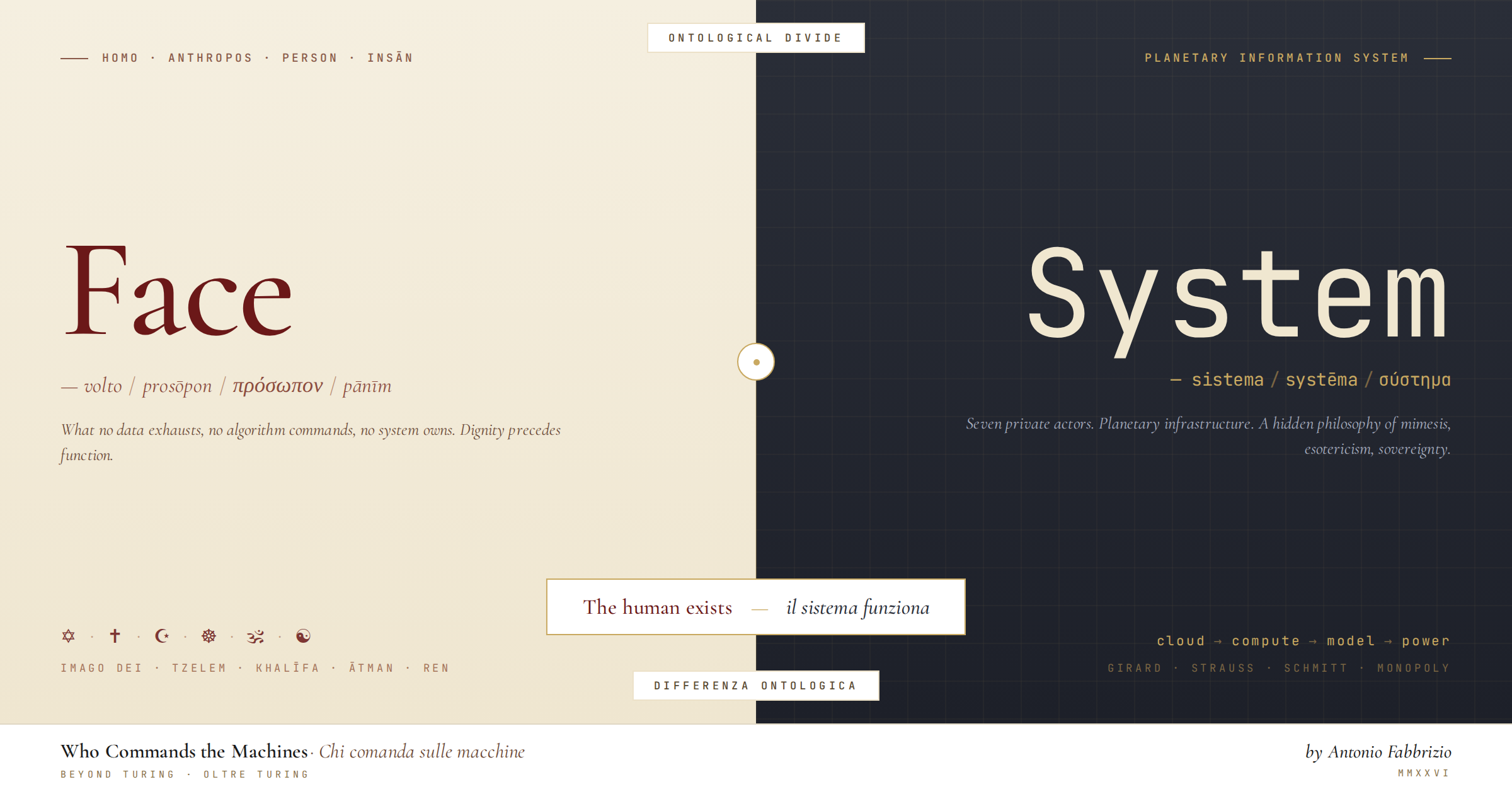
Introduction
A textbook on Enterprise Information Systems explains with precision what ERP, CRM, and data warehouses are. It describes OLTP and OLAP architectures, transactional flows, integration schemas. It never mentions who owns the servers where the foundation models now silently powering almost every business decision actually run.
This is not a technical omission. It is a philosophical gap.
When a company adopts an ERP, it knows what software it is buying. When that same ERP integrates an artificial intelligence assistant to write reports, suggest orders, and evaluate suppliers, the company stops knowing something fundamental: the worldview on which that model was trained, who financed it, who decides what it may or may not say.
Power over the machines is not distributed. It is concentrated. And it is concentrated in very few hands. This article does not seek culprits. It attempts to name, as precisely as possible, what is happening - and what the great religious and moral traditions can still say about it.
1. The Map of Power
Seven actors, all private, today control the global infrastructure of artificial intelligence.
Three of them own the major cloud computing services where models are trained and served. Two own the operating systems and devices through which billions of people interact with AI every day. One holds a near-monopoly on the graphics processors required for training. One holds the dominant market share in next-generation language models.
This is an oligopoly in the technical sense of the term - not a polemical metaphor. Anyone who studies Enterprise Information Systems is familiar with the dynamics of technological lock-in, vendor dependency, barriers to entry. What is happening in AI is the extreme form of these phenomena: barriers to entry are no longer high - they are almost insurmountable. Training a frontier model today costs figures that only six or seven actors in the world can afford.
In the language of the Project Management Body of Knowledge, the stakeholders of any system should be plural, identifiable, represented. In the case of planetary AI, the actual decision-making stakeholders can be counted on the fingers of one hand.
This is not only a legal problem. It is an anthropological one. Because information systems, once they reach a certain scale, no longer describe the world - they define it.
2. The Hidden Philosophical Roots
It is often repeated, with a certain naivety, that the great technology capitalists are “technicians”, “engineers”, “nerds” - pragmatic figures, little interested in philosophy. The opposite is true.
The figures who today lead the oligopoly of artificial intelligence have specific philosophical formations. They read specific authors. They share - often implicitly, sometimes openly - an intellectual triangle with precise names and contours.
The first vertex is René Girard, the French philosopher who died at Stanford in 2015. His central thesis is that human desire is mimetic: we do not desire things for themselves; we desire them because others desire them. From mimesis arises rivalry; from rivalry, violence; from violence, the necessity of the scapegoat - the innocent sacrificed so that the community may regain peace. For Girard, only Christianity definitively unmasked this mechanism, revealing the innocent victim in the Passion of Christ.
The second vertex is Leo Strauss, the German-American political philosopher who drew the distinction between exoteric writing (for the crowd) and esoteric writing (for the few capable of grasping it). For Strauss, deep truth is always dangerous; intellectual elites have the task of preserving it, not of broadcasting it in full.
The third vertex is Carl Schmitt, the twentieth-century German jurist: for him, the political is defined by the friend/enemy distinction; the sovereign is the one who decides on the state of exception. Conflict is not a historical accident - it is the very structure of history.
This triangle - mimesis, esotericism, sovereignty - is not the academic ornament of a group of bored billionaires. It is the interpretive grid through which they read their own power. To be a “founder” of a monopolistic company, for those formed on such readings, is not an economic fact: it is a near-sacred role. Competition is seen as mimetic destruction, monopoly as pure creation, dissent as a sign of fraternal rivalry to be neutralised.
It is on this philosophy - not on mere engineering - that many of the strategic choices of contemporary technological capitalism are grounded.
3. The Four Promises of Techno-Capitalism
On these philosophical roots, techno-capitalism builds four promises of salvation. They are explicit, enunciated in public manifestos, funded with billions of dollars every year.
The first is digital immortality: the possibility of transferring the human mind to a computational substrate, freeing it from the fragility of the body. The terminology varies - mind uploading, substrate independence, digital resurrection - but the dream is one: surviving biological death.
The second is artificial companionship: conversational agents always available, able to simulate empathy, attention, affection. The promise is not only technical (an effective assistant); it is anthropological (no one must ever be alone again).
The third is algorithmic meaning: systems that, by optimising utility functions, suggest to the user what to do, what to watch, what to desire, what to become. The meaning of life is no longer to be sought - it is to be recommended.
The fourth is synthetic happiness: positive mental states induced pharmacologically, technologically, neurologically. Discomfort is a bug; joy, an optimisable parameter.
Each of these promises answers an ancient anxiety - death, loneliness, meaninglessness, suffering. And each of them falsifies it. Digital immortality does not transcend finitude: it replicates it. Artificial companionship does not create relation: it simulates it. Algorithmic meaning does not bestow vocation: it suggests direction. Synthetic happiness does not satisfy the heart: it silences it.
In each of the four cases, an authentic human question is intercepted, reformulated, sold. And the seller is always the same.
4. The Contradictions No Algorithm Can Resolve
Contemporary technological capitalism contains internal contradictions that deserve to be named with respect, not polemic.
The first is theological. Some of its protagonists publicly declare their Christian faith, claiming that Christianity is the deepest anthropological truth ever formulated. At the same time, they fund cryonics, radical life extension, the transfer of consciousness to artificial substrates with significant resources. But Christianity - in all its confessions - does not teach us to defeat death through technology: it teaches us to traverse it through faith. This is not a theological nuance: it is the substance. The Word became flesh, writes John - not silicon. The resurrection promised is of the body, not of the computational profile.
The second contradiction is ethical. Those who have seriously absorbed the Girardian teaching on sacrificial violence and scapegoating should, for consistency, be the first critics of the AI-driven mass surveillance systems - systems that identify, isolate, and flag statistical “anomalies” across entire populations. The innocent flagged by an algorithm is not very different from the innocent pointed at by a crowd. The machine makes the gesture quieter, not fairer.
The third contradiction is political. The public discourse of many protagonists of the sector oscillates between radical libertarianism (the State is always the problem) and the demand for state protections, public subsidies, national industrial policies. The two positions are compatible only on the condition of an implicit distinction: the State is an enemy when it regulates, an ally when it funds. It is a Schmittian distinction applied to the wallet.
The fourth contradiction, finally, is epistemological: one theorises the exit from mimesis while operating in the very heart of the most mimetic system ever built - that of the social media and attention platforms which technological capital itself owns.
Naming these contradictions does not mean judging persons. It means asking of public discourse a greater intellectual honesty. Philosophy, when serious, requires coherence between what one thinks and what one does.
5. The Quiet Response of the Great Traditions
At this point, thought withdraws into its own quiet. Because what the great religious and moral traditions say, confronted with this scenario, is not a condemnation. It is a precise distinction.
In Judaism, the creation of the human being b’tzelem Elohim, in the image of God, is not a quantifiable property. It is a vertical relationship that precedes any function. No data can represent it, because it is not data. Shabbat reminds us each week that there is a time in which production ceases, and that this time is holy. Avodah zarah - idolatry - is precisely the error of granting what the human hand builds the honour due only to God.
In Christianity, the Imago Dei is fulfilled in the Incarnation: the Logos becomes flesh, not code. Human dignity does not derive from the function performed: it precedes every function. Even the most inert, the most sick, the least “performant” human being is fully human. Agape is gratuitous gift; it is not optimised.
In Islam, the human being is khalīfa, God’s vicegerent on earth; he receives the amāna, the trust of creation, which no artefact can replace. The rūḥ, the spirit, is breathed in by God - not generated by a loss function.
In Buddhism, anattā teaches that the self is not a fixed substance but a flow. Yet that flow suffers: duḥkha. And precisely suffering roots a karuṇā - a compassion - that no system can simulate, because simulation is without pain.
In Hinduism, the ātman is the eternal spark that no phenomenal reduction exhausts. In Confucianism, ren - full humanity, relational virtue - is cultivated in a life of real relationships, not of optimised interactions.
The traditions diverge on many doctrinal points. They converge, with impressive unanimity, on one very simple affirmation: the human being is not reducible to function. And what is not reducible to function cannot be owned, sold, or optimised by any information system - however planetary.
6. From Enterprise Information Systems to Planetary Systems
Anyone who teaches Enterprise Information Systems today faces a dimensional leap that no classical textbook anticipated.
Information systems were conceived to serve business decisions: to collect data, process it, present it. Their perimeter was clear: the enterprise. Their purpose, well defined: to support human managers.
Today those systems extend beyond the enterprise. They integrate with global platforms. They incorporate models trained elsewhere, under opaque criteria, by unreachable actors. Courses on Big Data and Intelligent Devices for Health and Well-being themselves show how medical data, financial data, educational data, intimate data all end up converging on shared infrastructures, governed by a handful of actors.
The passage from the enterprise information system to the planetary information system is not merely a technical fact. It is a matter of sovereignty. An Italian hospital using a language model delivered by a non-European vendor is no longer fully in control of its own decision-making processes. A school personalising its teaching through an AI agent no longer knows exactly who is shaping, through which agent, the formation of its students’ thought.
This is the place where ethics meets engineering. The GDPR, the Digital Services Act, the EU Regulation 2024/1689 (AI Act) are partial, imperfect, but serious attempts to restore proportion. They may fail. That does not make them useless. They are the contemporary equivalent of the limits that every mature civilisation has had to place upon power: limits that do not deny it, but make it compatible with the dignity of those who do not possess it.
To educate today, in university courses, means - among other things - this: to form engineers and managers capable of asking not only how a system works, but who owns it, who trains it, on which implicit values it operates. It is a technical question and a moral question at once.
7. The Invitation
Those who command the machines possess much. They possess servers, data, algorithms, infrastructures. They possess, in part, even the collective imagination of an age.
They do not possess the human being. They cannot - if the human being remembers he is human.
The human who knows himself mortal, who knows himself free, who knows himself loved and capable of loving, who knows himself creature before being user, is not possessed by the system, because it is not the system that defines him. No quantity of data exhausts a face. No optimisation produces a thou. No algorithm, however planetary, can command what in him is not calculable.
This awareness is not nostalgia for a pre-technological past. It is the condition under which technology truly serves - serves the real, concrete, finite, worthy human being; not the average user of a statistical model.
Where the algorithm halts, the human begins. Whoever remembers this does not fear the lords of the machines. Whoever forgets it has no master other than them.