 Beyond Turing
A patient wears a wrist device that samples cardiac rhythm at 250 Hz, peripheral oxygen saturation at 1 Hz, triaxial acceleration at 50 Hz. A classification algorithm, trained on tens of thousands of labelled traces, flags with high confidence a pattern compatible with paroxysmal atrial fibrillation. The device sends an alert to the electronic health record. The physician receives a notification. The patient - who feels nothing - receives a recommendation to contact their cardiologist.
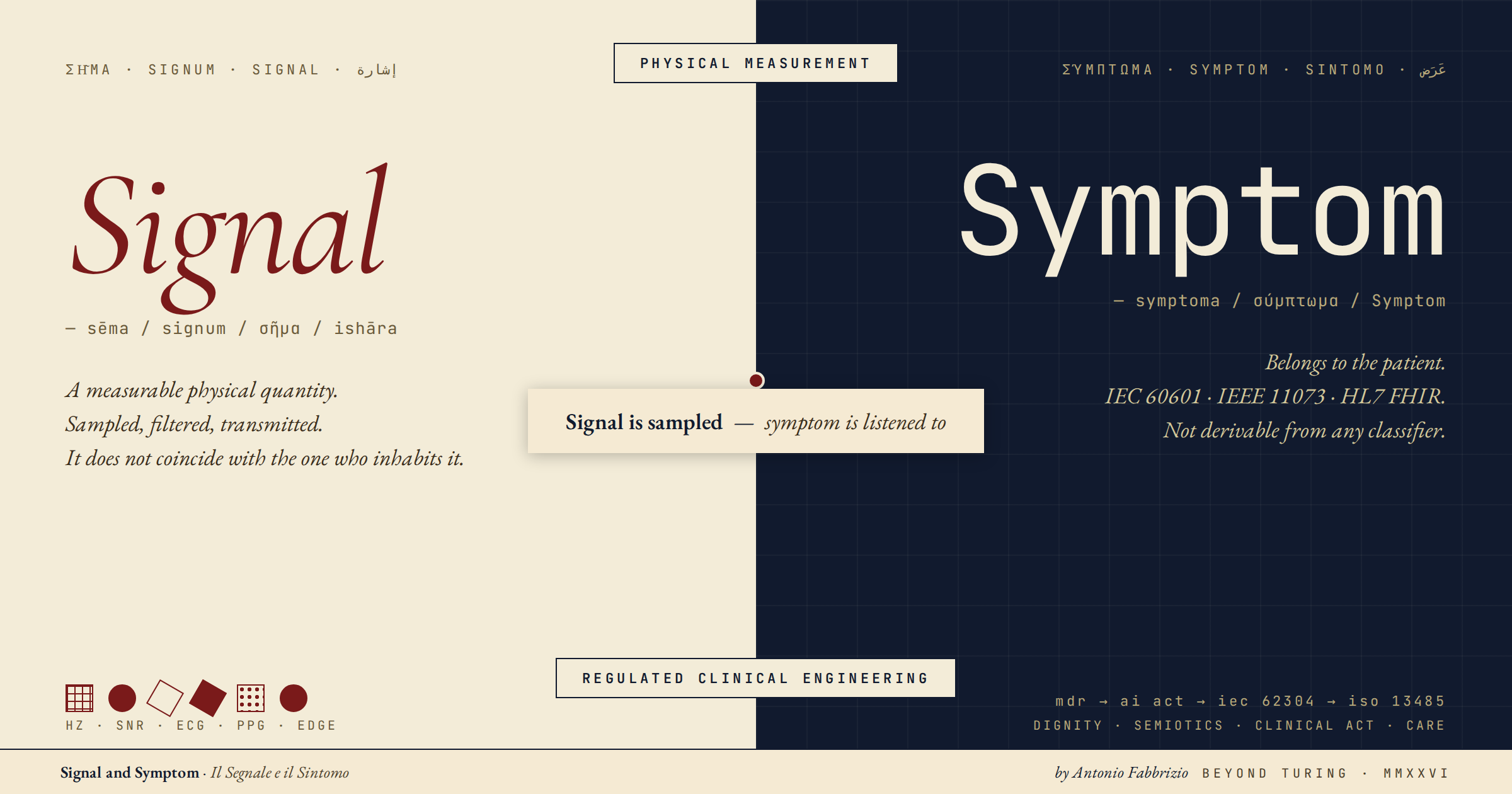
In this operational sequence - now routine in the clinical practice of OECD countries - two categorially distinct entities coexist. The electrocardiographic trace is a signal: a measurable, quantifiable, transmissible, storable physical quantity. Atrial fibrillation is a symptom: the clinical manifestation of a pathological condition, belonging to the patient's lived experience, to the anamnesis, to the physician's judgement. The engineering of intelligent medical devices - Internet of Medical Things (IoMT), wearables, Software as a Medical Device (SaMD) - lives entirely within the passage from the first to the second. Every architecture, every algorithm, every interface is a design choice on how this passage must occur, with what guarantees, under what responsibility.
This article reconstructs that passage from the standpoint of the engineer who designs, validates, and governs AI-enabled medical devices, within the regulatory framework of Regulation (EU) 2017/745 (MDR) combined with Regulation (EU) 2024/1689 (AI Act). It is not a clinical treatise. It is an engineering analysis of the non-functional requirements that the difference between σῆμα and σύμπτωμα imposes on contemporary design practice.
§1. The signal as measurable quantity
A biosignal - ECG, PPG, EEG, EMG, GSR, inertial data from accelerometer and gyroscope - is engineeringly characterised by a set of verifiable parameters: sampling rate (Hz), bit resolution, signal-to-noise ratio (SNR), bandwidth, acquisition latency. The Nyquist-Shannon sampling theorem sets the lower bound of the acquisition frequency at twice the highest spectral component of interest. The acquisition chain is, in principle, fully designable: sensor, analogue front-end, anti-aliasing filtering, analogue-to-digital conversion, pre-processing, compression, transmission.
In contemporary wearable devices - clinically validated smartwatches, single-lead ECG patches, intelligent plasters, optical PPG sensors - the chain is miniaturised and distributed. The sensor is at the wrist, at the chest, at the fingertip. Edge computing filters, compresses, extracts elementary features. Transmission to the gateway (typically a mobile device) occurs via Bluetooth Low Energy or low-power proprietary protocols. The cloud backend consolidates, stores, analyses, serves predictive models.
The relevant engineering metrics are codified in consolidated standards. IEC 60601-2-47 disciplines safety and performance requirements for ambulatory electrocardiographic systems. IEEE 11073 defines semantic interoperability of personal medical devices. ISO/IEEE 11073-10101 provides the standard nomenclature for clinical terminology. HL7 FHIR - in particular the Observation, Device, DeviceMetric resources - structures the semantic exchange between device and healthcare information system.
Up to this point the signal is, to all effects, a neutral engineering artefact. A numerical vector, a temporal trace, an EDF or MFER file. Its nature changes the moment it crosses the boundary that transforms it into clinically actionable information. That boundary is, simultaneously, a software interface and a threshold of responsibility.
§2. The symptom as irreducible clinical category
The symptom belongs to a different order. In classical medical semiotics - from Hippocrates to Laennec, up to contemporary evidence-based medicine - the symptom is what the patient reports (subjective manifestation), while the clinical sign is what the physician observes (objective manifestation detectable on examination). The biosignal captured by the wearable occupies an epistemologically intermediate space: it is objective physical measurement, but it is not yet clinical sign - because it becomes such only through the interpretive act of the physician, within the context of anamnesis, clinical history, dialogue with the patient.
This distinction is not philosophical pedantry: it is system architecture. A classifier that emits the label "paroxysmal atrial fibrillation detected" is not producing a diagnosis - it is producing probabilistic evidence requiring diagnostic confirmation. Semantic confusion between these two operations is one of the most frequent causes of clinical error in AI-enabled systems: automation bias, extensively documented in the literature on decision support systems (Goddard et al., 2012; Lyell and Coiera, 2017), is the human operator's tendency to over-rely on algorithmic output, even when declared confidence is modest.
The architectural mitigation of this asymmetry requires the device to communicate to the physician not only the label but at least four quantified pieces of information: the posterior probability associated with the class; the confidence interval of that probability; the presence or absence of out-of-distribution factors with respect to the training population; the traceability of the data that contributed to the prediction (attention maps, SHAP values, counterfactual explanations). All four are today the object of active standardisation - in particular in the FDA guidelines on Good Machine Learning Practice for Medical Device Development (2021), in the ISO/IEC 23894 requirements (AI risk management, 2023), and in ISO/IEC 42001 (AI management system, 2023).
The symptom, in the full sense, is not the classifier that detects it - it is the experience of the patient, contextualised by the physician, confirmed by investigations. The intelligent device serves this process: it does not replace it.
§3. IoMT architectures and risk classification
The Internet of Medical Things ecosystem is articulated on a now-consolidated stratified architecture. At the edge level operate terminal devices: first-level wearables (physical activity, sleep, heart rate), clinically validated wearables (single-lead ECG, clinical-grade SpO₂), implantable devices (pacemakers, loop recorders, insulin pumps), environmental sensors (indoor air quality, temperature, humidity for frail patients). At the fog level - home gateways, smartphones, hospital hubs - the first aggregation occurs, end-to-end encryption, buffering to guarantee continuity in case of connectivity interruption. At the cloud level reside longitudinal storage, AI models, decision support systems, integration with the electronic health record.
Each of these levels is subject to a specific regulatory framework. The physical device falls under Regulation (EU) 2017/745 (MDR): risk classification (I, IIa, IIb, III) according to the rules of Annex VIII; CE marking; clinical evaluation under Annex XIV; post-market clinical follow-up. For software devices - MDCG 2019-11 clarifies the qualification of SaMD and establishes its classification. An algorithm providing therapeutic or diagnostic recommendations in contexts that may determine critical treatments or alterations of clinical state typically falls into class IIa or higher.
Regulation (EU) 2024/1689 (AI Act) overlaps with the MDR where the device integrates AI components. Art. 6(1) in conjunction with Annex III classifies as high-risk systems AI-enabled medical devices (where already subject to third-party conformity assessment under harmonised sectoral regulations, including the MDR). This entails additional requirements: risk management system (Art. 9), data governance over training-validation-test datasets (Art. 10), technical documentation (Art. 11), automatic logging (Art. 12), transparency to the professional user (Art. 13), human oversight (Art. 14), accuracy, robustness, and cybersecurity (Art. 15).
The duplication is not redundancy: it is stratification. The MDR protects the clinical safety of the device as an artefact; the AI Act protects the integrity of the algorithmic decision-making process. The manufacturer must orchestrate both conformities - typically within an ISO 13485 quality management system, an ISO 14971 risk management process, an IEC 62304 software lifecycle, an ISO/IEC 42001 AI management system. The result, at steady state, is a technical dossier whose accountability perimeter is fully verifiable.
§4. From acquisition to decision: the governed clinical pipeline
The pipeline that transforms a raw biosignal into a clinically relevant decision traverses, in order, seven verifiable stages. Acquisition: compliant sensor, traceable calibration, synchronised timestamp. Pre-processing: filtering, denoising, removal of artefacts (motion artefacts, baseline wandering, mains interference). Feature extraction: extraction of temporal, spectral, non-linear parameters (RR intervals, HRV, QT interval, spectral entropy, sample entropy). Model inference: application of the trained classifier or regressor, production of the probabilistic output. Uncertainty calibration: conformal prediction, ensemble disagreement, Bayesian calibration of the output. Presentation to the clinician: interface that exposes label, confidence, local explanation, possibility of counterfactual querying. Decision and documentation: the physician confirms, modifies, or rejects the output; the decision is recorded in the electronic health record with full trace.
Each stage has specific engineering metrics and, at the same time, asymmetric clinical relevance. An upstream SNR degradation does not only compromise the classifier's numerical performance - it modifies the epistemic trust the clinician can legitimately place in the output. A distribution drift between training and deployment is not only a statistical problem - it may correspond to clinical subpopulations systematically underrepresented (sampling bias by age, sex, ethnicity, comorbidity), with direct implications for the equity of treatment received. The literature has extensively documented these effects (Obermeyer et al., 2019, on algorithmic bias in population health management; Seyyed-Kalantari et al., 2021, on the differential performance of imaging classifiers for demographic subpopulations).
The design implication is that post-market monitoring is not an ancillary maintenance activity - it is integral to the system. Art. 61 MDR and Art. 72 AI Act prescribe, respectively, post-market surveillance plan and post-market monitoring system. In engineering terms, this means: continuous telemetry of performance metrics stratified by subpopulation; automated drift detection with quantitative thresholds and defined alerts; planned re-training with explicit quality gates; incident reporting traceable end-to-end to the competent authority. The lifecycle of the AI-enabled device is, at steady state, a continuous governance cycle.
§5. The clinical remainder
No IoMT architecture, no Bayesian calibration, no XAI explanation exhausts the patient. The biosignal measures a physical quantity, not a person; the classifier labels a class, not a biography; the decision support system informs a choice, it does not make it. The clinical decision - the one that establishes whether to intervene, how to intervene, when to intervene, taking into account comorbidities, personal history, patient preferences, family and social context - remains a medical act, inscribed in the care relationship, not derivable from any model.
Mature clinical engineering does not seek to reduce this remainder: it structures it. It inscribes it in standard operating procedures as an explicit moment of human validation; it dimensions it in interfaces as cognitive space protected for medical deliberation; it preserves it in workflows as a point of non-algorithmic bypass. The human oversight of Art. 14 AI Act, when lowered into the clinical domain, is not a courtesy concession: it is a functional specification that traverses the entire technology stack.
Hence the maturity of the contemporary synthesis between Digital Health and Evidence-Based Medicine: the intelligent device does not aspire to replace clinical judgement, but to make it better informed, more timely, more equitable, more traceable. The biosignal expands the temporal window of observation - from the hours spent in clinic to the days, weeks, months of continuous monitoring. The algorithm extracts patterns the human eye does not grasp. The cloud infrastructure consolidates data that would otherwise be dispersed. But the clinical reading - the act that inscribes data in the meaning of a person - remains the irreducible prerogative of the physician, in dialogue with the patient.
An IoMT system designed with this awareness is not less powerful - it is better located. It knows what it measures, knows what it does not measure, knows where its own competence ends and clinical competence begins. This engineering consciousness of its own boundaries does not weaken health technology: it makes it credible, deployable, sustainable. It is not timid engineering: it is mature engineering.
The signal can be sampled. The symptom must be listened to. The biosignal is the quantity; the symptom is the person who inhabits it. An intelligent medical device that recognises this distinction is not less effective - it is better designed. And a medicine that does not forget this distinction is not less technological - it is more true.